Letters › Scent Mythology › Literary Figures
Scent Mythology · Literary FiguresEmily Dickinson and the Garden of Invisible Things
Scent Mythology is an imaginative Eau & Co series. These conversations are fictional, created as a playful way to explore scent, memory, art, and personal meaning.
An imaginary Eau Method conversation on flowers, paper, sunlight, and learning to notice what moves us.
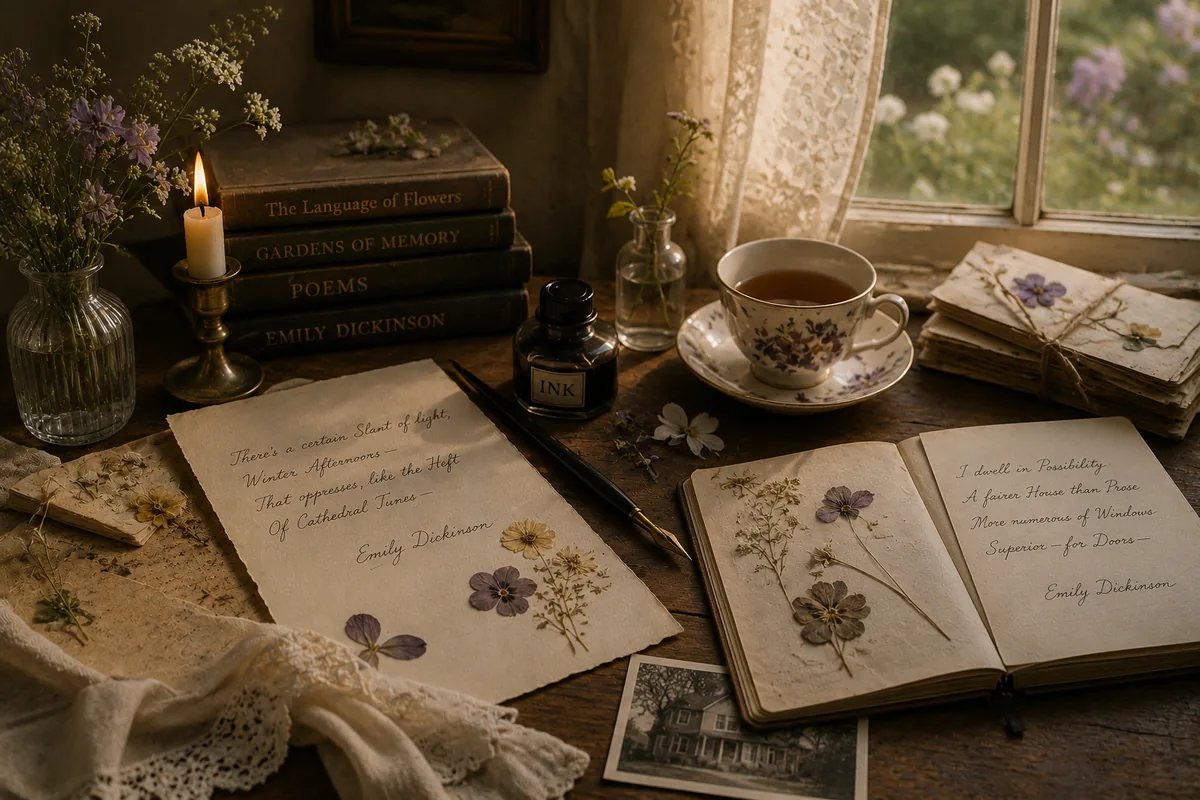
Emily Dickinson arrives quietly. Not because she is timid, but because quiet is where she keeps her instruments. She chooses a table near the window. There is a small glass of water, a folded piece of paper, a pencil, and flowers that look as though they were gathered not for decoration, but for conversation. The room smells of clean cotton, pressed petals, beeswax, garden soil, paper, and sunlight resting on wood.
She does not ask what perfume is fashionable. She asks what the air is doing. And so we begin.
01 — Notice · Scent Awareness
Question: When was the last time something invisible moved you?
Emily looks toward the window. "There is a certain Slant of light," she says, as if light itself has weight. For her, the invisible is never empty. A room has weather. A flower has a voice. A letter carries the hand that wrote it. The garden is not outside the house; it is another way of thinking.
She notices the faint sweetness of petals before they fully open. The powder of old paper. The waxy softness of a candle. The coolness of morning air. The green bitterness of stems. The way sunlight changes the smell of wood.
Her first scent lesson is simple: you do not need a dramatic life to be deeply moved. You need attention.
Emily's scent awareness is not loud. It does not arrive as perfume first. It arrives as air, light, paper, garden, fabric, breath. She reminds us that scent begins before the bottle. It begins with noticing.
02 — Remember · Scent Autobiography
Question: How would your story change if memory had a scent?
Emily touches the edge of the paper. "I dwell in Possibility," she says.
Her scent autobiography would not be a straight line. It would be a drawer of folded notes, a garden path, a white dress drying in sunlight, a flower pressed between pages, a room where someone has just left and yet something remains. Her memories might smell like white cotton, violet, clover, beeswax, ink, envelopes, wood floors, garden soil, tea, and the cool shadow of a room in the afternoon.
If memory had a scent, Emily's story would not become larger in the ordinary sense. It would become more precise. The scent of one flower could become a whole season. The scent of paper could become a voice. The scent of sunlight could become proof that something beautiful happened, even if quietly.
For the reader, this is the second lesson: your scent history is not made only from perfumes you have worn. It is made from what stayed with you.
A kitchen. A hallway. A person. A garden. A school bag. A clean towel. A summer storm. A book. Memory already has a scent. The work is learning to recognize it.
03 — Reframe · Healing and Reframing
Question: Would you let a scent rewrite the ending to a memory?
Emily smiles slightly. "Tell all the truth," she says, "but tell it slant."
She would not ask scent to lie. She would not want perfume to cover the truth with sweetness. But she might allow scent to approach a memory from another angle. A lonely room could be given sunlight. A difficult silence could be given tea. An old ache could be given flowers that do not demand anything. A memory that once felt closed could be given a window.
This is what scent can do gently. It does not erase. It does not pretend. It shifts the atmosphere around what happened.
Emily's reframing scent would not be sugary or loud. It would be tender, but intelligent: violet leaf, clean cotton, beeswax, soft woods, paper, and a little green stem. Not "everything is fine," but more like "there is still beauty here." That may be enough.
04 — Hold · Perfume as Vessel
Question: Would you let a perfume hold your memory more gently than time ever did?
Emily pauses. "Hope," she says, "is the thing with feathers."
For her, perfume could become a small vessel of hope: not bright optimism, not forced happiness, but a quiet presence that keeps singing somewhere inside. A scent can hold what is too delicate to explain. The first day after a loss. The morning before a change. The courage to begin again. The softness of being loved. The private wish to be understood.
Emily's perfume would need to hold air and stillness. It would need to feel like something perched lightly in the soul: white flowers, pale woods, beeswax, clean fabric, crushed green leaves, and a trace of warmth. Not a fragrance that announces itself. A fragrance that stays near.
The lesson here is that perfume can be a keeper. It can hold a version of you, a season of life, a promise, a prayer, a private note folded carefully and placed somewhere safe.
05 — Reveal · Taste and Identity
Question: Would you trust a fragrance to reveal how you see the world?
Emily answers without hesitation. "The Soul selects her own Society." Her taste is selective. Not cold. Not unfriendly. Selective. She does not need every flower in the garden. She needs the right one. She does not need every room. She needs the room where thought can breathe. She does not need fragrance to impress. She needs fragrance to understand silence.
Her scent identity is quiet, observant, floral, green, paper-soft, luminous, private, exacting, and unexpectedly strong. She would not wear a perfume that tries too hard. She would not want something overly sweet, overly polished, or overly obvious. Her fragrance would have edges of restraint and flashes of wonder. It might smell like a flower before it becomes romantic. A page before it becomes a letter. Sunlight before it becomes afternoon.
This is Step Five of the Eau Method: noticing not only what you like, but what your taste reveals about how you see the world. Some people see the world in gold. Some in smoke. Some in clean linen. Some in roses. Some in rain. Some in coffee. Some in salt air. Some in soft skin and quiet woods. Emily sees it in possibility.
06 — Translate · Signature Scent
Question: Can fragrance become the language for something you've never said aloud?
Emily lowers her eyes to the paper. "I'm Nobody," she says, but there is mischief in it. Not emptiness. Not disappearance. A chosen privacy. Her unspoken sentence might be: I do not need to be loud to be infinite.
That is the fragrance we would try to translate. Not a perfume of performance. Not a perfume of social approval. Not a perfume that enters before she does. A perfume of interior life. Something that says: I notice. I imagine. I feel deeply. I keep my own counsel. I am not small simply because I am quiet.
Emily Dickinson's Scent Profile
Scent Direction: Soft floral, paper, garden air, beeswax, clean cotton, pale woods, green stems, sunlight, and quiet warmth.
From Her Time: Violet water, rosewater, lavender, pressed flowers, beeswax candles, clean linen, ink, paper, and garden herbs.
From Our Time: For a modern interpretation of Emily's scent profile, we would look for fragrances that feel quiet, perceptive, and close to the skin: delicate iris, violet, pale musk, paper-like woods, green stems, clean cotton, and soft garden air. Possible directions might include a powdery iris or violet worn alone, a skin musk used as a foundation, or a green floral that feels more like petals and stems than a full bouquet. A very light beeswax, honey, or tea note could add warmth, but it should remain delicate — never sugary, heavy, or loud.
As reference points, one might explore soft musky florals such as Diptyque Fleur de Peau, rain-washed florals in the spirit of Frédéric Malle En Passant, or quiet lavender-incense textures similar to Serge Lutens Gris Clair. These are not meant as definitive "Emily" answers, but as modern doors into her atmosphere: paper, garden, cotton, air, and inwardness.
A layering idea for this profile could be: clean musk + violet or iris + the faintest trace of honey, beeswax, tea, or incense. The result should feel like a flower pressed inside a letter, not a bouquet placed on display.
The Eau Reverie — The Garden of Invisible Things
The Eau Reverie is the fragrance imagined from the consultation: a scent that may not exist in a bottle yet, but exists clearly in atmosphere, memory, and feeling.
If Eau & Co created Emily's scent in an imagined world, it might be called The Garden of Invisible Things. It would open with violet leaf, clover, and cool morning air. At the heart, pressed flowers, white cotton, beeswax, and paper would create the feeling of a small room near a garden. The base would rest on clean skin, sunlit wood, pencil shavings, and the softest trace of tea. Not a perfume that announces itself. A perfume that notices.
Eau & Co Reflection
Emily Dickinson is the perfect first guest for Scent Awareness because she reminds us that the invisible is not empty. A scent does not have to be expensive to move you. A room does not have to be grand to become unforgettable. A flower does not have to be rare to become part of your story.
Before you become your own scent curator, begin as Emily begins: notice the light. Notice the paper. Notice the garden. Notice the air.
The fragrance that belongs to you may begin as something very small. A petal. A cup of tea. A clean sleeve. A window. A breath. And then, suddenly, possibility.
Today, choose one invisible thing that moved you: a smell, a shift in air, a light in the room, a flower, a fabric, a food, a page, a breeze. Write one sentence: "This moved me because…" That sentence may be the first line of your scent autobiography.
Selected quoted lines are from Emily Dickinson's public-domain poems, including "There's a certain Slant of light," "I dwell in Possibility," "Tell all the truth but tell it slant," "'Hope' is the thing with feathers," "The Soul selects her own Society," and "I'm Nobody! Who are you?"
More Letters
The Scent Library Letters: A Living Archive of Fragrance, Memory, Imagination, and Self-Curation
Read the letter →
The Invisible Things That Move Us
Read the letter →