Letters › You Are Already a Scent Curator › The Invisible Things That Move Us
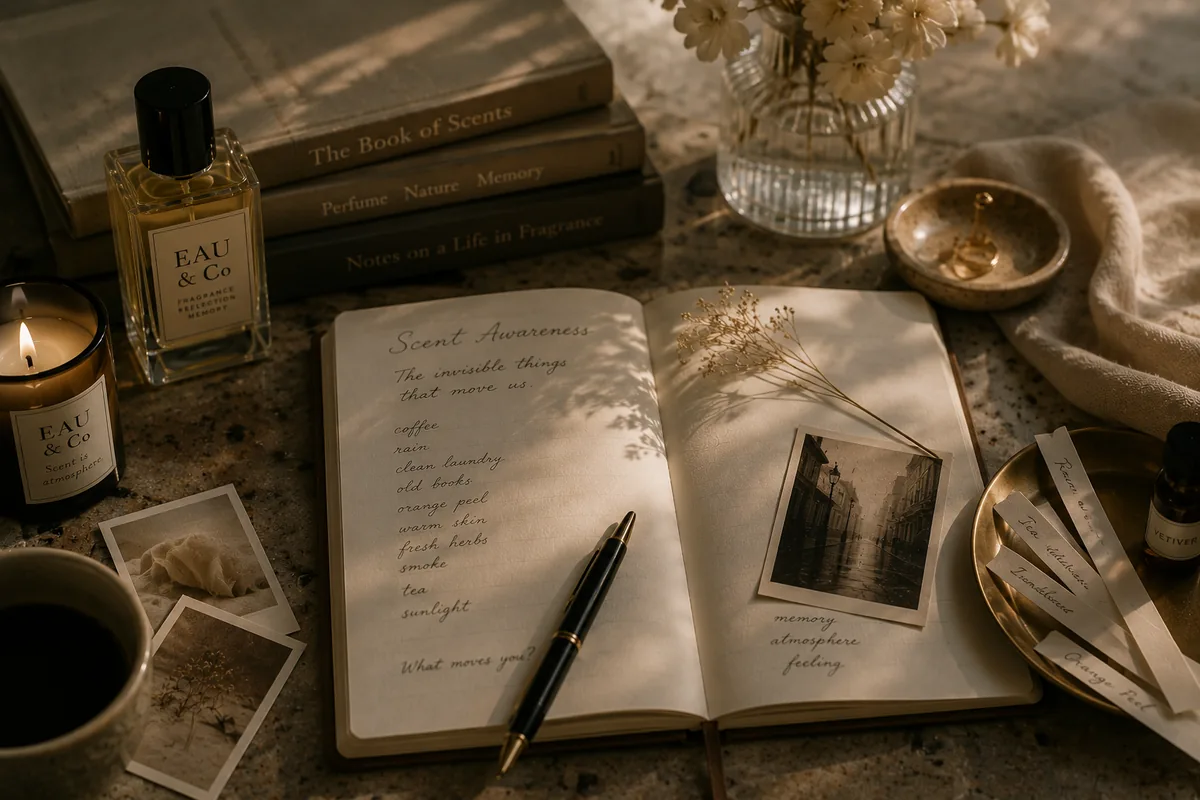
Step One · Scent AwarenessThe Invisible Things That Move Us
Welcome to The Scent Library Letters.
You Are Already a Scent Curator is a guided scent journal for anyone who wants to understand fragrance as memory, identity, care, and personal art. It follows The Eau Method, a six-step self-curation process inspired by the questions at the heart of Eau & Co.
Through reflection, scent exercises, and small daily observations, you will begin to notice what moves you, map your scent memories, understand your taste, and translate something deeply personal into fragrance direction.
You do not need to buy anything to begin. You do not need to know perfume notes, own expensive bottles, or have the "right" vocabulary. You only need attention.
Each article in this series is designed to stand on its own. You may follow the full Eau Method step by step, or you may use only the part that speaks to your current need. Every letter will include one central idea, one reflection, and a small piece of homework. Later articles in each step will build on what came before, but the first practice is always simple: notice what is already around you.
Because before you choose a scent, you learn how you are moved by one.
Step One: Scent Awareness — The Invisible Things That Move Us
Eau Method Question: When was the last time something invisible moved you?
Scent is invisible, but it changes the room. It can soften a morning before anything good has happened. It can bring back a person before you have said their name. It can make a place feel safe, unfamiliar, romantic, sterile, expensive, lonely, alive, or impossible to forget.
Before fragrance becomes a bottle, it is an atmosphere. The smell of coffee before work. Warm skin after a shower. Rain on concrete. A drawer with old scarves. Smoke from someone's jacket. Rice cooking. A clean shirt. Freshly cut herbs. A hallway that smells like school. A hotel lobby. A church. A hospital. A bakery. A summer car. A winter coat pulled from storage.
You already respond to scent all the time. You may simply not have been taught to treat your response as information. This is where self-curation begins. Not with asking, "What perfume should I wear?" But with asking:
- What invisible things have shaped me?
- What do I keep returning to?
- What makes me feel comforted, alert, beautiful, protected, or more myself?
A scent curator is not someone who knows every perfume. A scent curator is someone who knows how to pay attention. And you are already doing it when you choose one candle over another, when you dislike a detergent, when a certain soap makes you feel clean in a deeper way than another soap does. You are doing it when one bakery smell feels joyful and another feels too sweet. You are doing it when you realize that "fresh" does not always mean citrus, that "warm" does not always mean vanilla, and that "clean" does not always mean laundry.
Your taste is already present. It only needs to be listened to.
Scent awareness is the first step because it separates what you actually feel from what you think you are supposed to like. Many people begin fragrance discovery by copying someone else's answer. They ask what is popular, what is elegant, what gets compliments, what is "sexy," what is expensive, what is considered good.
Those questions are not useless. But they are not first questions.
The first question is more private:
What moves me before I explain myself?
This matters because perfume is intimate. It lives on skin. It follows breath, heat, fabric, memory, and mood. A scent can be beautiful and still not belong to you. A scent can be simple and still feel like home. When you begin with awareness, you stop chasing the abstract idea of a perfect perfume. You begin building a scent language from real life.
- Maybe you are moved by the smell of black tea, old books, and cold air.
- Maybe you are moved by orange peel, clean cotton, and sunlight.
- Maybe you are moved by coffee, roses, and a warm kitchen.
- Maybe you are moved by smoke, leather, and rain.
- Maybe you are moved by powder, lipstick, and vintage mirrors.
- Maybe you are moved by soap, skin, and quiet.
None of these are wrong. Each one is a clue.
A Small Practice Before Perfume
Today, do not start by looking for perfume. Start by smelling your life. Choose five ordinary things around you. They do not need to be beautiful. They only need to be real.
- Your coffee
- Your shampoo
- A spice jar
- Your clean laundry
- A wooden drawer
- A piece of fruit
- The air outside
- A book
- Your hand cream
- Rice, bread, tea, paper, flowers, soap, fabric, rain
Smell each one slowly. Then ask: What does this make me feel? Not what is it supposed to smell like. Not whether it is "good." Not whether someone else would like it.
What does it do to you?
- Does it calm you?
- Does it sharpen you?
- Does it make you miss someone?
- Does it make you feel capable?
- Does it make you feel younger?
- Does it make you feel elegant?
- Does it make you want to leave?
- Does it make you want to stay?
This is the beginning of your scent vocabulary.
Not bergamot, amber, musk, iris, aldehydes, vetiver. Those words can come later. First: comfort, tension, softness, distance, memory, clarity, hunger, safety, longing, warmth, discipline, joy.
Perfume language begins as emotional language.
Scent Library Homework
Today, smell five ordinary things in your day and write down what feeling each one creates. Use this format:
Object: > What I smell: > What it reminds me of: > What it makes me feel: > Would I want this feeling in a perfume?
Example:
Object: Black tea > What I smell: Dry leaves, warmth, slight bitterness > What it reminds me of: Quiet mornings, books, discipline > What it makes me feel: Focused and calm > Would I want this feeling in a perfume? Yes, but only if it stays soft and not too sharp.
Do this without trying to sound poetic. Accuracy is more useful than beauty. The goal is not to create perfect answers. The goal is to begin noticing your own.
Today's Reflection
A personal scent does not begin at the perfume counter. It begins in the invisible moments you already respond to: the air after rain, the warmth of a kitchen, the softness of fabric, the trace of someone you love, the atmosphere of a place you cannot forget.
You are already a scent curator because your body has been collecting impressions long before you had words for them.
This week, let yourself notice.
The scent that belongs to you may not announce itself immediately. It may begin as a feeling. A memory. A texture. A room. A season. A quiet yes.
More Letters
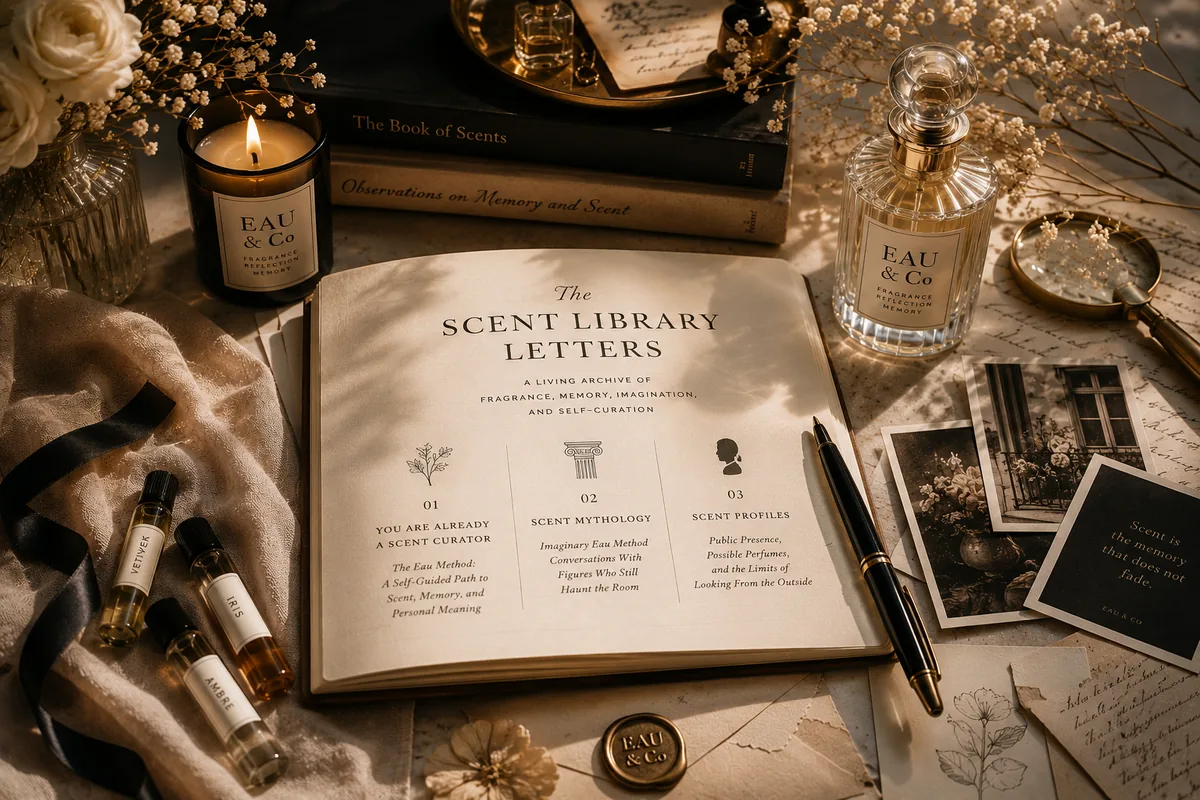
The Scent Library Letters: A Living Archive of Fragrance, Memory, Imagination, and Self-Curation
Read the letter →
Emily Dickinson and the Garden of Invisible Things
Read the letter →